Tokyo Dome
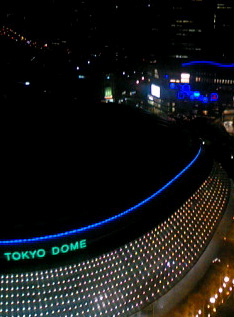
Site of the first-round games for Pool A teams China, Chinese Taipei, Japan and Korea.
Site of the first-round games for Pool A teams China, Chinese Taipei, Japan and Korea.
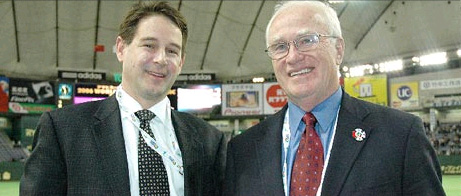
Inside the Tokyo Dome with Paul Archey, our Senior Vice President for International Business and organizer of the World Baseball Classic.
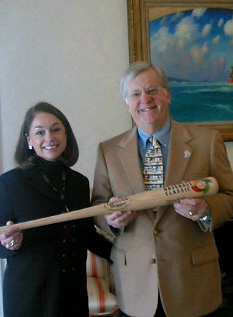
A real highlight of the trip was breakfast at the United States Embasssy, hosted by Ambassador J. Thomas Schieffer and Mrs. Susanne Schieffer.
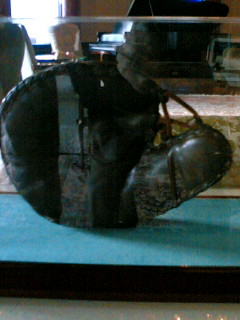
I blogged about this Mizuno glove that Ambassador Schieffer keeps on display at the U.S. Embassy in Tokyo. It was presented to Lou Gehrig during a 1934 barnstorming tour.
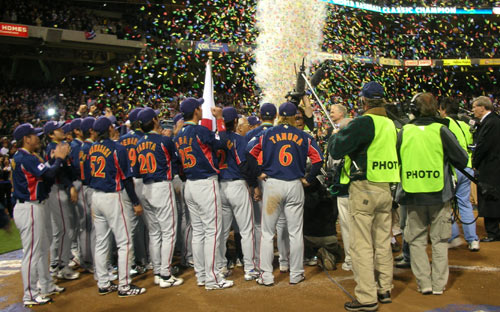
This has been a March unlike any other around baseball. Here are some photos from my experience throughout the inaugural World Baseball Classic.
Orlando
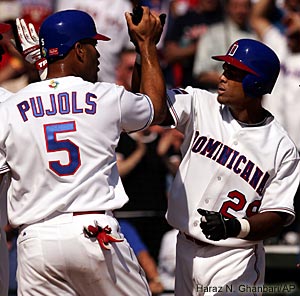 While Chuck Armstrong, president of the Seattle Mariners, traveled all the way to Japan to watch Ichiro perform for the advancing Japan team last week, the star from the Seattle roster so far in Round 1 has without a doubt been here in Orlando. Adrian Beltre hit his third home run in two games, leading the Dominican to its berth in Round 2 with an 8-3 victory over Italy, which finished its Round 1 eliminated at 1-3. Beltre shows signs of returning to 2004 form where he whacked 48 home runs and batted .334 for the Dodgers before slipping to 19 home runs and .255 last year in his first season with the Mariners. In the second game tonight, Venezuela also advanced, beating a tough Australia team with knuckleballer and secret weapon 35-year-old Phil Brassington, who did not play at all last year but who gave the winning team fits for four innings. Pretty tough to pick which country — Venezuela or the Dominican Republic — has the most enthusiastic fans. We’ll wait until San Juan to decide, where we have the four teams advancing everyone eagerly awaited. The big Puerto Rico/Cuba showdown tomorrow night may give a preview of next week’s coming attractions.
In Phoenix, the tiebreaker suspense was broken early when Mexico threw a four-spot at Canada in the first inning after two were out. If the U.S. beats South Africa tomorrow, they advance, sending Canada home despite its thrilling victory over the U.S. yesterday.
Tiebreakers are tricky things, but necessary in a tournament of this type. Ron Blum of the Associated Press reminded me of a very controversial tiebreaker, when West Germany and Austria advanced out of the first round of the 1982 World Cup. Algeria had upset West Germany and West Germany beat Austria 1-0 in the final game of the round robin, allowing those two teams to qualify at Algeria’s expense. All three had gone 2-1, but based on the 1-0 score, the two European teams advanced. Observors believed that the 1-0 score was not accidental and investigations ensued.
Ratings continue to grow. The U.S./Canada game on ESPN2 surpassed the game the day before and is now the highest-rated show on ESPN2 this year, giving the Classic the first- and second-place shows. As a measuring stick, the games thus far have outrated the regular-season NBA games on ESPN and ESPN2 this year by a significant margin. No doubt interest in the novice event is growing and hopefully the matchups in Round 2 will only enhance your interest.
Before we head on to Round 2 over the weekend, a few answers to some of the questions that have been posed in the postings.
I have to miss the Orlando finale tomorrow between Australia and the Dominican Republic, but we’ll see you in San Juan. Keep watching, listening and subscribing.
Orlando
The Italian
team, which had such potent bats against Australian pitching on Tuesday night, ran into a pair of solid Major League performers — two time All-Star Freddy
Garcia from the World Champion Chicago White Sox and Carlos Silva of Minnesota ,
who has won twenty-three games over the last two years and had a solid 3.44 ERA
last season.
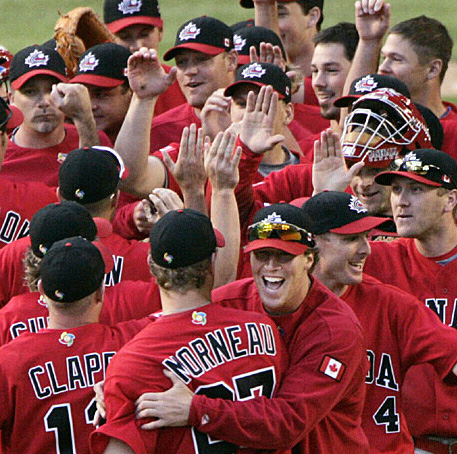
And of course the Canadian stunning win over the USA, leaving the
U.S. team hoping that Canada beats Mexico, and they beat South Africa (which gave
Canada all it could handle) or else relying on the vagaries of the tie-breaker
to advance.
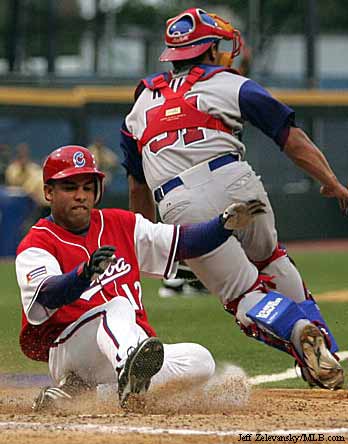 ESPN did some nifty footwork today, allowing fans to
maximize their viewing, continuing the Cuba/Panama game to conclusion on ESPN2,
doing some look-ins on Canada/U.S. first and then putting it on ESPN and then
simulcasting a couple of innings on ESPN and ESPN2 after the Cuba/Panama game
ended and then finishing the Canada/U.S. game on ESPN2. Nice to have two networks
with exposure to about 90 million homes each to be able to do that kind of
juggling and keep all the fans of all the teams happy!
One pleasant surprise is how competitive a number of
teams without long baseball traditions have been. South Africa gave Canada
fits, the Netherlands played Puerto Rico tough in their debut and Italy
dominated Australia before getting shut down tonight by Venezuela, before a
sellout pro-Venezuelan crowd.
Some real differences between the fans today and the
six games in Japan. In both places the fans were knowledgeable, intense and
took the game outcomes very seriously. But there are differences:
A few notes from Japan since my last posting.
Speaking of ESPN, technology is an amazing thing. I had connectivity for the
whole flight each way to and from Japan on JAL. While I was slugging away doing
emails and listening to XM radio online, I looked at my watch and realized it
was 5:30 a.m. in New York. I switched over to ESPN radio, heard the last
half-hour of the overnight show and then the first two hours of Mike and Mike.
It was great to hear Mike Greenberg, just back on the air, acknowledge on the
basis of the exhibition game between Puerto Rico and the Mets that his
skepticisim about the Classic was misplaced and that in his words the event "had
juice". After the games today, he should be even more enthused. Lots of good
games: U.S./Mexico, D.R./Venezuela, Panama/Puerto Rico. A great day and night.
I would be remiss if I did not mention how sad we all are about the passing
of Kirby Puckett. His career was sadly cut short by illness and now, more
tragically, his life was cut even shorter. His joy of the game, his enthusiasm,
would have no doubt made him a willing and exciting participant in this type of
tournament. He obviously will be missed in Minnesota and all over baseball.
See you tomorrow.
International Baseball could not have asked for a better game than the finale of the Asia Pool tonight. Before a noisy crowd of over 40,000, which included a rare public appearance by His Imperial HIghness the Crown Prince Naruhito and the Crown Princess Masako, visiting Korea beat Japan in an intense, well-played game, 3-2. Although the game was played only for bragging rights, since each team moves on to the second round in Anaheim next week, the participating teams put to rest any idea that these games would be played as exhibitions and not full out.
Nowhere was that more present than in the key fourth inning. Two plays in the bottom of that inning probably turned the game around. Japan was already leading, 2-0, and threatening to blow the game open. First, Korea’s shortstop threw out Japan’s Iwamura trying to score on a ground ball. What was remarkable is that Iwamura tried to bowl over the Korea catcher Cho, In Sung, a play not generally seen in professional baseball as it is played in Japan. For the final out of the inning, with the bases loaded, Korean righfielder Lee, Jim Young made a diving catch on a ball hooking away from him to save three runs from scoring. And in a dramatic climax to the round robin, Chan Ho Park got Ichiro to pop up for the final out of the game, preserving the one run victory for Korea, which will now open up the second round in Anaheim facing the Pool B (US, Canada, Mexico, South Africa) runner-up next Sunday.
The appearance of the Crown Prince had been rumored all weekend, although public sightings are not commonplace. He attended one of the opening games between the Mets and Cubs in 2000 at the start of that season, but has not attended any of the All-Star Tour games that have taken place before or since. His appearance, along with the Commissioner of Nippon Professional Baseball, the former Commissioner of NP, and the Chairman of Yomiuri Holdings, at the game underscored its importance here in Japan.
Fan behavior here is significantly different from a game in the States. Here, the fans never boo, and never vocalize as individuals. There are organized cheers for every player, and organized Thunder Stixx slapping or rattle shaking for every strike or out or hit. The large but obviously outmanned Korean fan section carried on their cheering loudly throughout the entire game. Polite applause greets every out or good defensive play. In an atypical occurence, the loudest noise came when Ichiro was hit by a pitch in the sixth inning, although it was more of a drone than a yell. Neither the players nor the managers nor the fans react overtly to any call of an umpire, although there did not appear much to complain about on that front through any of these games.

I mentioned the Lou Gehrig glove that Ambassador Schieffer keeps on display at the U.S. Embassy and today I have posted a picture (right). The glove was manufactured by Mizuno and presented to Gehrig during a 1934 barnstorming tour. He brought it back to the States and apparently used it for some games in 1935. It is on loan to the Embassy from the National Baseball Hall of Fame and was recently refurbished by Mizuno after 70 years. Imagine trying to scoop up errant throws from infielders with that glove.
I thought of the recently deceased Vic Power when I saw the glove and how hard it would have been for even him to make flashy catches with a glove like that. I am sure I thought of him both because he was such a slick fielder but also given the participation of his native Cuba in the Classic.
All segments of Baseball were well represented in Tokyo. In addition to the Japanese executives I mentioned above, Commissioner Shin, the new Commissioner of the KBO, came and watched his tenure get off to a good start in international competition. Aldo Notari, President of the International Baseball Federation was on hand along with Miguel Ortin, the Executive Vice-President. From the U.S., Chuck Armstrong (right) of the Seattle Mariners, and MLB’s International Committee watched all of the games.
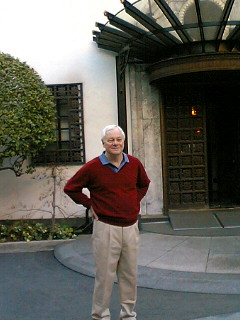
Gene Orza of the Players Association who has spent more than full-time on this event for months was here as a member of the Technical Committee along with his colleagues Phil Bradley and Steve Rogers. MLB had Sandy Alderson of the Padres, Chairman of the Technical Committee, EVP John McHale, another member of the Technical Committee and Paul Archey, Senior Vice President, International, and the person most responsible for putting together all of the logistics and commercial aspects of the entire tournament. And I would be remiss if I did not mention the sponsorship and organization skills of host Yomiuri, which has been a staunch supporter of international baseball for years, and the great and supportive MLB organization in Japan led by Jim Small, Senior Vice-President along with Sami Kawakami, Darrick Thomas, and Hiroko Kato. They all made everyone’s lives much easier given the number of games in such a short period. And Tommy Lasorda continued his role as Ambassador-at-Large for the Classic with his boundless energy and enthusiasm.
Overall, the first round-robin was a success. There were no real competitive surprises. Attendance for the six games exceeded 100,000. The Japanese games were well-attended, the non-Japan games much less so, perhaps because the China and Taipei teams were not as competitive. We do not have television ratings yet, but I would guess the game tonight did very well in both Korea and Japan. The 14-to-17 hour time difference in the States no doubt will keep the ratings for these games there low. The games were well-played, the players were well-conditioned, and the pitch counts did not seem to have an overall impact. The winners of Pool B will have their hands full next week facing rested Korea and Japan teams.
On to Orlando, and the remaining Round 1 venues. The Venezuela-Dominican Republic game Tuesday to lead off the Orlando Pool should be every bit as good as tonight’s finale.
The games today went according to form. While solid fundamentally due to the coaching skills of Jim Lefebvre and Bruce Hurst, the Chinese team was thoroughly outmatched by Korea. China had only one hit for the first seven innings before a solo home run in the eighth got China its only run. In the game tonight — before by far the largest crowd so far of the week — Taipei did not have the pitching to match its Game 1 performance against Korea, and as a result were thoroughly trounced by Japan. So, as expected, Korea and Japan will take 2-0 records into their showdown tomorrow night, although both will be on their way to Anaheim for Round 2.
While tomorrow night’s game does not really matter overall, my expectation is that both teams will play to win the pool and beat their rival In the first round-robin of the first Classic, form prevailed. In the category of every time you go to a game you see something new, the catchers for both Korea and Taipei had their own resin bags sitting on the ground next to them, making a matched pair with their pitchers.
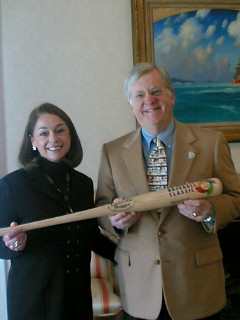
A real highlight of the trip was breakfast today at the United States Embasssy, hosted by Ambassador J. Thomas Schieffer and Mrs. Susanne Schieffer (pictured at right). Ambassador Schieffer, of course, was formerly involved as a principal of the Texas Rangers at the same time as President Bush and has previously served as the Ambassador to Australia. It is impossible to visit the magnificent and historic building, now almost 80 years old, and not think of General Douglas MacArthur walking up the driveway in September, 1945 for his meeting with the Emperor. The tournament also gives you a chance to reflect on how far we have come and how athletic competition can unite countries. Now teams from China, Taipei, Japan and Korea are competing for a chance to come to the United States and compete against other former — and in some cases current — political rivals. Having Ambassador Schieffer now ensconced in the embassy in Japan with his baseball background, love of the game, and memorabilia collection that is prominently displayed (including a glove Lou Gehrig used in a tour of Japan) made the event that much more special. Baseball is clearly spoken here — not just at the Tokyo Dome — but at the United States embassy as well. Gene Orza of the Players Association and I presented the Ambassador with a bat commemorating this first World Baseball Classic that we hope years from now will also be memorable.
The Tokyo Dome is an interesting place to watch a game. It is a lot like the Metrodome in Minneapolis, with the roof held up by an airlock so the entrance doors are all revolving doors or have two part entrances so the air can keep the roof up. It holds about 50,000. One feature of all the stadiums in Japan is that the screen that we have behind the plate in stadiums in the Major Leagues extends all the way down the foul lines for the protection of the fans. Even with that, every time a foul ball is hit into the stands, an usher in the section of the approaching ball blows a whistle and after the ball hits, the public address announcer admonishes fans in both Japanese and English to "Watch out for foul balls" and a similar message appears on the scoreboard in both languages. While the timing of the announcement may be odd, the warning is certainly clear. There are two exposed auxiliary sections down the line in front of the screens and each seat in those sections comes with a hard hat that patrons are expected to wear. The food vendors, all women, come to the bottom of each aisle, bow politely, display their wares and then start up the aisle. Beer is vended from coolers located on the vendors’ backs, and the assortment of food is quite wide — from bratwurst to sushi, and from dried seaweed to ice cream.
Interest in the event seems to be growing back in the States from what I see online, spurred by the assembly of the United States team. I saw two very positive articles on ESPN.com on the spirit of the event, one by Jayson Stark on how much this event means to the Latin players and countries and one by Jerry Crasnick talking about the U.S. team. As the rounds get under way in Orlando, Phoenix, and San Juan, that enthusiasm is bound to grow.
When we first starting talking about this event, the first thought was why not have it after the season is over in November. But as the event unfolded and more thought was given, November does not work for a lot of reasons. Our goal was to get as many of the best players in the world as possible, and everyone involved believed that March provided a much better chance of doing that than November. As Al Leiter said yesterday, not every great player has chosen to play, but there is assembled in the event the greatest collection of players ever for a single tournament or game. By November, the players would have gone through an entire Spring Training and played an entire 162-game season. Eighty percent of the players would have been off for an entire month, after the grind of the entire season. Those who had been through the playoffs and World Series would have played up to another 19 games and been asked to play after the emotional roller coaster of the postseason. Japanese and Korean players would have had a similar experience. Not a single one of the 16 baseball federations involved expressed the view that November was a better time. Our broadcast partners have a much tougher schedule in the fall with college and professional football filling up airtime and the start of the new fall season, so showing all the games would not have been likely. In addition, the cost of insurance for the players was much higher, since the risk of injury after a full season was greater than playing in the spring. On balance, very little commended November for the event.
I also respectfully disagree with those who say that the tournament severely disrupts Spring Training and consists of out-of-shape players. Certainly the four teams playing here in Japan are in great shape. Maybe 30 years ago, players came to camp in bad shape, mostly because they worked during the offseason at other jobs, but today, the overwhelming majority of the players come to Spring Training ready to play physically and use Spring Training to hone their skills. Most of the players participating in the tournament are veterans who would only play a few innings of each Spring Training game, and of course, half of the teams will go home after one round, and all but four will be done by the second week, so the number of players actually out for a protracted period of time compared to the number of players in all Major League camps is quite small. This modest disruption once every four years does not seem so bad in comparison to what we hope will be the overall impact of the event.
 Bob's Classic Chronicles